– YouTube
Enjoy the videos and music you love, upload original content, and share it all with friends, family, and the world on YouTube.
Our Eyes Lead the Brain
 The body has great power to lead the mind. In Richard Wiseman’s interesting book, As If Principle, he lines up a large quantity of recent studies showing how a change of muscle tone, posture, and other seemingly small adjustments to the body produce large changes in mental status. Changing eye positions can also yield large changes in our states of mind.
Eye Position 1: Gazing Off Into Space – We don’t often admit it but we all stare off into space (or television, or computer screen) from time-to-time. Our conscious minds flip off and our self identity is gone for at least those staring moments.
The next time you snap out of staring, stop and notice where you have been staring. Was it downward? To the left, right, straight on? Later, when you have some downtime, let your gaze return to this spot and see if you find yourself drifting quickly inward or if at least, see if your mental chatter falls off.
Eye Position 2: Story Telling Gaze Spot – When we get going, recounting some event or story to a friend, we switch our gazing around. Sometimes it is to the eyes of the listener but frequently we start gazing downward at the floor or a point some distance away. This is especially true if we have to switch inward and recover memories and memories of our feelings or deeper thinking about what we are talking about. It is as though we have to shut down the stimuli coming into our minds by staring off at some unremarkable point and this allows us to drop into our memory and thinking processes. The next time you are telling such a story, notice where you eyes fix. Bring that observation up when you wish to do some solitary deep thinking and fix your eyes in the same position and see if this pulls you more deeply within.
Eye Position 3: Eyes-Closed, Looking Straight Ahead Sharper Mind Gaze – When we close our eyes to go inward, we let our eyes drift to the same location they follow when we are falling asleep. In stage 1 of sleep our eyes are dropped and almost “crossed”. As we go deeper into this stage our eyes move in an asychronous manner. When doing imagination work, try breaking out of this position by keeping your eyes closed but bring your eyes up to the central position you would use if you were looking at someone straight on when your eyes are open. Notice any change in mental clarity. Usually this position has a waking effect that might be useful to bring greater clarity to your visualizations and related work.
Eye Positions 4 to 9: Eyes-Closed, NLP Gazes – After highly detailed study of the work of innovative hypnotist Milton Erickson, researchers discovered that people assume a variety of eye positions as they turn inward. When trying to remember a visual, auditory, or body memory people will look to the left. When trying construct a visual, auditory, or body imaginative experience, people look to the right. The chart below show the NLP gazes in greater detail.
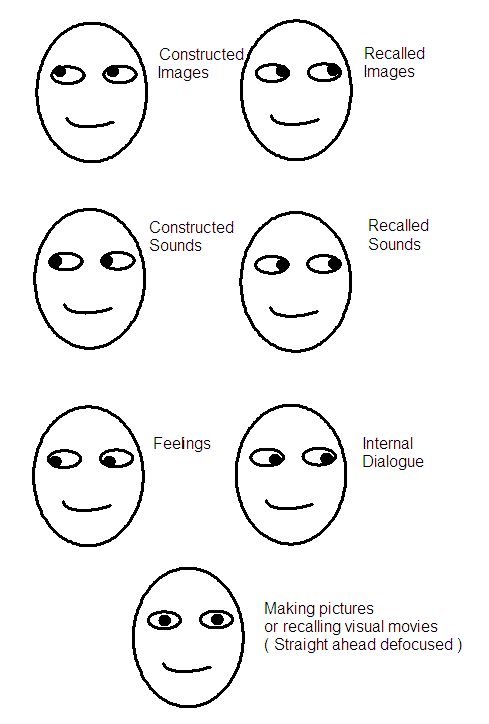
Experiment: Now for putting those gazes to work. With eyes closed and in a good state of relaxation, move your eyes into one of the positions and let them rest there. Note if images or other sensory impressions come up or not. Move slowly from each position to position, explore as you go.
Experiment: Some find that mind chatter falls away by moving the eyes into the looking right positions. Going right means we are trying to construct images which may be a powerful counter to mind chatter focused on the past such as guilt, shame, or faulting for taking action or lack of action in the past. If we are troubled by future concerns such as worry, perhaps looking left, towards memory might silent the construction-ability that is part of worry (worry is a constructed view of the future). This is especially helpful during those times when troubling images or inner talk is pressing down on us.
[youtube=http://www.youtube.com/watch?v=t0aqkDkNeqw&w=420&h=315]
Truth: Powerful techniques can be learned and mastered quickly
 The media has exposed us to all sorts of exotic, hard-to-learn, long-time to master methods of stress management. Zen masters, biofeedback pros, hypnosis experts, and yoga gurus have their place and make great copy but they don’t have the corner on all things related to stress. Learning a few simple and powerful techniques can change your life. Got two minutes? Learn the following techniques. Spend some time to master them and you will have three friends for life.
Find Yourself by Finding Your Body
When we are in the thick of things our attention is cast outward and frequently carries our projections of what we think we are seeing in the people and events of the moment. When we are caught inwardly, we are away from our basic and simple selves and are in the past, future, or in some sort of analysis. When we need a break from either or both, all we need to do is find ourselves by finding our bodies. When we find our bodies, we pull back our projections and outward bound attention and we stop our mental time-travel.
1. Withdrawal your attention from the outside events and from your inside mind chatter and direct it towards finding your body.
2. Scan your body from head to toe, not looking for anything too special but just feeling your body
3. Repeat the scan but this time focus on scanning in the middle of your body. For instance, start at the top of your head and assume that you are focused in the middle of your head, the middle of your throat, the middle of your chest, middle of your stomach, and the middle of your pelvis. Next, feel yourself scanning down the middle of one arm and hand and next the other. Next move to each leg. The goal is feel the solidity of your body.
4. Repeat these scans as many times as you wish to bring your attention more and more to your body.
Flow Along With Your Breath
Your breath takes care of itself and it works sort of like the sea. Waves of air are drawn in and the tides of air go out. Watching the smooth rhythm of your air waves takes your attention, mind and heart along on this easy journey.
1. Come back to your body and find your breath.
2. You don’t have to change its speed or depth. Just start to follow it by focusing on the in and out of your breathing at the tip of your nose, at the up and down movement of your chest/belly, anywhere you can see the changes of inhalation, pause, exhalation.
3. Follow the flow.
Contacting the World
We contact the world in many ways but the most basic is the small area where we place our body against the surface of a chair, couch, bed, or ground. This is truly contacting the world. It is point that has some tactile and gravity pressure sensations and it is a good way to anchor us within simple reality for a moment or two.
1. If you are seated, be aware of where your butt, hips, and back touch the chair. If you are lying down, feel the larger area that is in contact with the surface of what you are touching.
2. Note all sensations of this intersection across the entire area that is in contact.
3. Hang out there as long as you want.
Technique Ratings and Notes:
Speed to relaxation onset: Quick
Level of relaxation experienced in first 2 minutes: Mild to moderate
Where can it be used: Anywhere
How noticeable when being practiced: Invisible
Best use (pre-stressful event, during stressful event, post-stressful event; general relaxation): All uses
Difficulty/speed to learn: Easy and fast
Equipment required: Perhaps a watch but a watch is not really necessary; go on feel.
Finally, Affordable Brainwave Biofeedback
 In the 1970s and 80s there were alpha brainwave trainers at decent prices, but they were rough around the edges and only worked with one brain wave frequency. In more recent years, ADHD stimulated some development of hardware for concentration improvement and arousal control. With a prescription and about $1,500, Brainmaster made much more powerful and flexible devices available.
Now, for less than $200, broad-spectrum equipment is available that plugs into your PC (not available for Mac, yet).
To get there, you have to buy two things.
The Hardware: Neurosky
About two years ago Neurosky was introduced to the market. It was an attractive, light-weight, and practical headset that plugged into a PC. It provided some interesting feedback through showing a large spectrum of brainwaves on screen. Two protocols were built into the software: “attention” and “meditation.” Color bars and waving lines also appear on screen but, the fine print says, they are for illustrative purposes and have been altered a bit to show better on the monitor.
Developers have come forward and produced some interesting games and, at last, software that pulls useful brainwave info from the application. About a year ago, the Mind Reflector people came forward with what I had been waiting for. But, before I say more about that, here’s more on the Neurosky headset.
Asif measuring his Brain Waves with Neurosky Mindwave Headset
http://www.neurosky.com/Products/MindWave.aspx
NOTE: If you want to with Mind Reflector, don’t get the headset that works with mobile phones. Get the USB version of their headset.
The Software: Mind Reflector
This is what brings the Neurosky headset alive for those who want to do brainwave work.
MindReflector C-1 Neurofeedback Training by MindReflector Technologies, LLC
MindReflector Neurofeedback Training provides true low-cost EEG Biofeedback training with dry-sensor technology utilizing the NeuroSky MindWave headset.
These Mind Reflector guys are clearly serious. They took their software and protocols to their peers in the neurofeedback field. They put everything out to be poked at and examined. To handle some of the critics, they compared the results of their software tied to Neurosky to clinical-level equipment, the Brainmaster. They found that the two devices returned very much the same results even though there was a $1,100 price difference between the setups.
Why Use it for Imagination Work?
First, the Neurosky/Mind Reflector setup can be used to learn how to relax well to do deeply into imaginal work. That is always an important step.
Secondly, the Mind Reflector guys included an Alpha/Theta training protocol which is tremendously valuable. I will write more about alpha/theta work but let me say here that this brainwave combination has been shown to take people to a deep place where important work can be done. This can include: memory recall, working with beliefs, creative breakthroughs and more.
This equipment and software gets my 5-stars.
Three Hats: Guided, Guider, the Observer of the Whole Thing
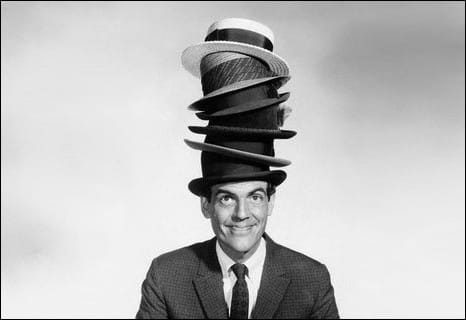 We naturally split ourselves whenever we practice some guided practice such as guided imagery or self-suggestion (aka self-hypnosis). We give part of our attention to the guider, some attention what we are experiencing, and there is a quiet observer that takes on the task of watching the process. Three hats at the same time are on top of our heads and we thought we were in deep relaxation.
Erika Fromm, in her research on self-suggestion, called this multi-hat process ego division, where our self-awareness gets allocated to three concerns. She even threw in a fourth, the doubter. Ah yes, there is the doubter. Our inner critic that has serious questions about the process, whether important things can be experienced, and whether we are the right person for the job. One more hat, please. Fromm did find that, at least in hypnosis, some people could do somethings better when guided than when they guided themselves. But she also found that some experiences were better in self-guided processes than when there was guider.
Find Out for Yourself – Guided or Self-Guided, Which Works Best for You?
First, get some guided imagery recording that you like and are very comfortable with (you don’t need the doubter rambling on about the guider, his/her voice, word choice, etc.) and work with it four or five times. Note what happens, what works and what doesn’t.
Next, use the same script, as best as you can recall or and/or take notes to self-guide. Use that approach four or five times.
Compare: How do the processes differ in terms of: getting deeper; getting more vivid imagery; getting involved in the action; effectiveness post guided imagery session.
From this work you can really sharpen your practice by knowing how you wear many hats and still get quality experiences and focusing on the most effective process for your interests/needs.
++++++++++++
Self-Hypnosis: The Chicago Paradigm – Erika Fromm and Stephen Kahn
Following and Flowing with En-Trancing Found Sounds

Most people have some sound, natural or man-made, that they know can grab their minds and en-trance it. Gentle rainfall, a fan, crickets chirping, a train passing, a rocking chair.
The common features of these en-trancing found sounds is a fairly steady rhythm that is seduces our mind and emotions into following it. Just following. No need to be critical of anything. How can you be critical of ocean waves, hmm of a hair dryer, or a car moving down the highway on a long trip? First we follow the sound and then we allow ourselves to let the sound lead us as we turn off our evaluative minds. Our larger world drops away as the sound covers over other competing sounds that might distract us or at least keep us vigilant, listening for trouble.
Making the transition between being very active and being very internalized and deep can be hard but here is a method to make that journey. Use a favorite found sound is an easy, direct, usually highly effective way to ease into deeper imaginal states and work.
Sounds to Try – Entrancing Found Sounds:
Nature Sounds:
Water – rainfall (on many different types of surfaces)
Water – waterfall
Water – stream
Water – waves
Birds
Night sounds
Jungle sounds
Swamp sounds
Wind
Frogs
Crickets
Owls
Fire – bonfire, fireplace
Heart beat
Human-made:
Electric fan
Wooden sailboat
Water sprinkler
Typewriter
Grandfather clock
Car
Train
Hair dryer
White noise
Brown noise
Pink noise
Vacuum cleaner
Jumbled human voices (i.e. cafe sounds)
Metronome
Ticking clock
Bathroom shower
Airplane
Windchimes
Motorboat on waves
Clothes dryer
Passing traffic on a city street
How to Find Them
Some of these are easy to find or setup such as floor fan, wind chimes, or ticking clock. If we can set them all we need to do then is position ourselves to hear them. Another way is use recordings via phone apps, desk computers, or mp3 files
See these sources for computer based found sounds:
simplynoise.com
purewhitenoise.com
soundsleeping.com – Compose your own mix of sounds or listen to single sound from an extensive recordings library
whitenoiseplayer.com
rainymood.com
Search your phone’s app store for: white sound; relaxation; and stress apps
Look through audio recordings at any large bookstore (online and bricks and mortar) or speciality seller of relaxation tunes.