04 Imagine - Articles

Imagery Training – Where to Find It

I wish I could say that there is imagery training everywhere at all sorts of levels, but that isn’t the case. There are only spotty opportunities to dig into imagery to any substantial degree, and you may have to travel some distance to get it.  Here is a list to work from and some suggestions on how to search for more.


Psychotherapy and Health Care Related Emphasis

Academy for Guided Imagery – Santa Monica, CA and online
The Academy (AGI) was created by a physician and a psychologist a few decades ago, mainly to offer imagery training to health care and mental health care professionals. Their current training maintains much of that focus, but the coursework is open to anyone.

Training centers around recordings of Drs. Marty Rossman and David Bresler in workshops supplemented with readings.  To advance to each higher level of training, a test must be taken and submitted to AGI. After a certain level, participants needed to complete an on-site half week training in Santa Monica. After that work, students then could go on to the next level trainings with a similar half-week course-work in California. These days, this work can be conducted by Internet conferencing around a set schedule.

Thoughts:  I highly recommend this very comprehensive program.  Disclosure: I have a certificate of completion from this program.

For direct information, see: www.acadgi.com/

Imagery International – Northern California (annual conference)
Practitioners from a variety of backgrounds conduct workshops at this annual fall conference. Imagery International also provides a bound newsletter that is published several times per year and is available to its membership.

For direct information, see: imageryinternational.org/

Center for Healing and Imagery – Washington, D.C.
Dr. Mark Lawrence started this training program a few decades ago and ran and taught until his passing in 2011. The emphasis had been on ego states (parts of ourselves), trauma therapy, and mindfulness meditation in therapy.

Thoughts:  I recommend this program, especially for therapists in need of continuing education credits. Disclosure: I have a certificate of completion from this program.

For direct information, see: www.centerforhealingandimagery.com/


General Exploration and Self-Therapy Emphasis

Bellruth Naperstak
Naperstak comes from a career in psychotherapy, so many of her recordings and books come from this emphasis.  With that said, her products are aimed not for the professional but for anyone who wants to explore imagery or work on themselves. Each recording is clear and follows a basic formula of starting off with relaxation and then a journey through archetypes appropriate for that recording.  Bellruth Naperstak does occasional workshops.

For direct information, see: http://www.healthjourneys.com/

Dr. Jerry Epstein – New York City
Dr. Epstein has provided insight and instruction for decades, and he continues to hold court in New York City. In recent years he has expanded into phone groups, which greatly expands opportunities to learn from him. His books are must-haves and give the reader much to think about and to explore.

For direct information, see:  http://drjerryepstein.org/

Leslie Davenport
Davenport also comes from a psychotherapy background but provides a book and training for those who wish to use imagery, personal issues, and healing. She provides CE for those who work through her book and does occasional training. She was also on the founding faculty of the Deep Imagination course work (see below).

For direct information, see: http://www.lesliedavenport.com/

Deep Imagination Certificate Program – John F. Kennedy University – San Fransisco
This is the only imagery program associated with a teaching institution that I know of in the United States. JFK University has been providing specialized training for several decades for those lucky enough to attend. Here, they offer a certificate in guided imagery through on-campus courses.

For direct information, see: http://www.jfku.edu/Programs-and-Courses/Continuing-Extended-Education/Deep-Imagination.html


Shamanism-Related Emphasis

Foundation for Shamanic Studies
This is the oldest organization that I know of with a shamanism-bent. Michael Harner started this years ago after the success of his book, The Way of the Shaman.  Imagination training centers around levels of imaginative depth, sonic driving to get people into imaginative states, and the use of symbolism from shamanic practice around the world. Harner provides training and training for those who will go on to train others. On his site, he has materials including recordings of shaman drums and rattles, but also a directory of teachers by geographical area.

For direct information, see: https://www.shamanism.org/

Trance Postures – Cuyamungue Institute
The late anthropologist Felicitas Goodman noticed that certain postures represented in ancient carvings were associated with spiritual activities and mystical states. Curious about this association, she tried several of the postures and discovered they enhanced imagination work. Goodman then went on to capture these images and theories in a few books and in training.

Belinda Gore has continued Goodman’s work and expanded it in easy to adopt books and training.

For direct information, see: http://www.belindagore.com/CuyamungueInstitute/tabid/657/Default.aspx

Deep Imagery of E. S. Gallegos
A few decades ago, Dr. Gallegos introduced the theory and practice of imaging power animals at power locations within the body. This became the basis of his personal totem pole process. Dr. Gallegos books are still available, and he does some teaching.

For direct information, see: http://www.esgallegos.com/

Recommended Search Terms for More Training:
sports imagery, shamanism, dreams, dreamwork, hypnosis and imagery, Jung Society, active imagination, imagery.

Also, check major bookseller for books on imagery. Some of those authors provide training.

07 Dreaming - Articles

[Book Review] Sleep Thinking – Eric Maisel

I don’t recommend that many books and the one’s that I do must be either a comprehensive treatment of a subject or one that has specific techniques fully outlined.  Eric Maisel’s book is both.

Maisel turns his psychologist/writer skills to the study of our unconscious and when it is doing it’s freest work, while we are sleeping. Among its many duties and capabilities is to do what Maisel calls, sleep thinking.

We are already familiar with sleep thinking.  “Give me some time to sleep on it,” is a common approach to decision making.  We know that some how, during our sleeping, a part of our brain will work away and make our options clearer by morning.

This behind the scenes work is different than studying our dreams. Sleep thinking is more to the point and sticks with what we are most concerned about. It isn’t overly poetic in what it shows us and sleep thinking results are more practical.

Eric Maisel is a precise man. His book is not filled fluff. He jumps in provides the step-by-step approach to sleep thinking and then offers specific directions for common areas of interest such as building creativity, removing inner obstacles, and finding solutions to large challenges.

The only special note I have about this book is this suggestion: start off easy and simple. Read the first chapters and then get down to work. Ask for insight or answers to something important to you and work that for a few days/a week. Repeat for another week or so.  Don’t get bogged down when starting a sleep thinking practice by taking on too much.  Get the principal down and do some preliminary work.  Then, if called, jump back into Maisel’s detailed work program.

This book is out-of-print but is still available ($1.00 to $4.00) so get it while you can. Here is the Amazon link.

The Kindle edition of this book is: The Power of Sleep Thinking – Link

04 Imagine - Articles

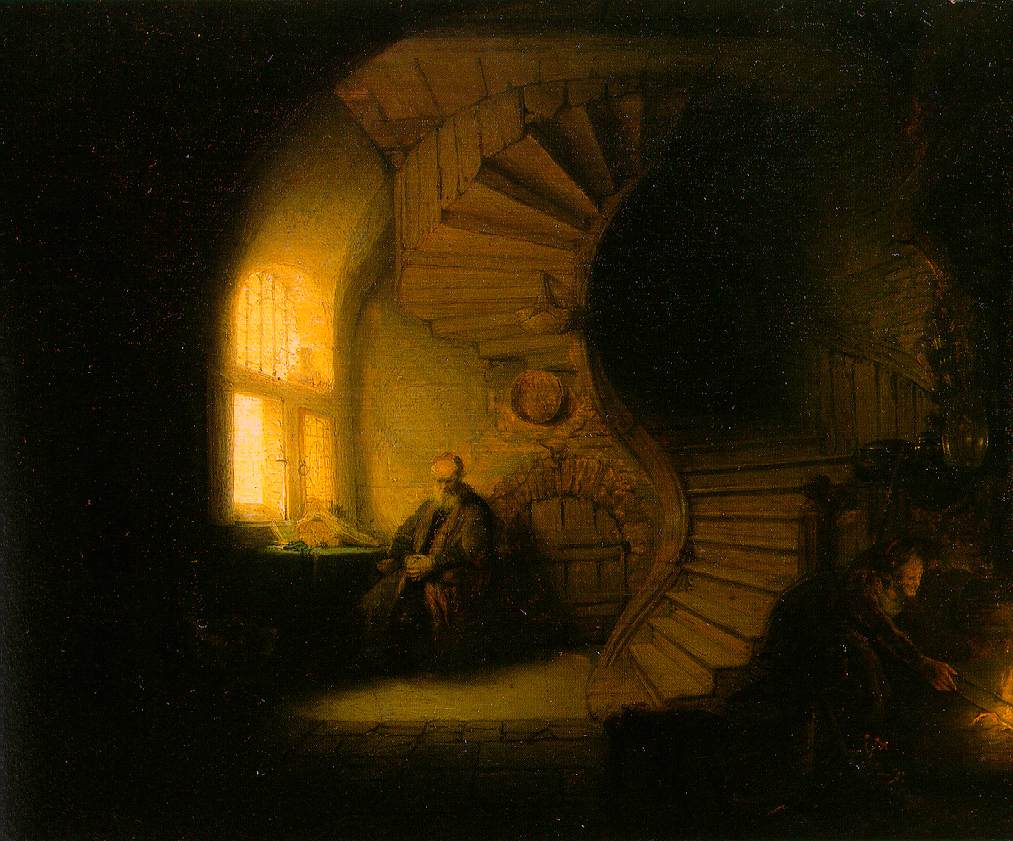
Rembrandt’s Image of the Place of Imagination

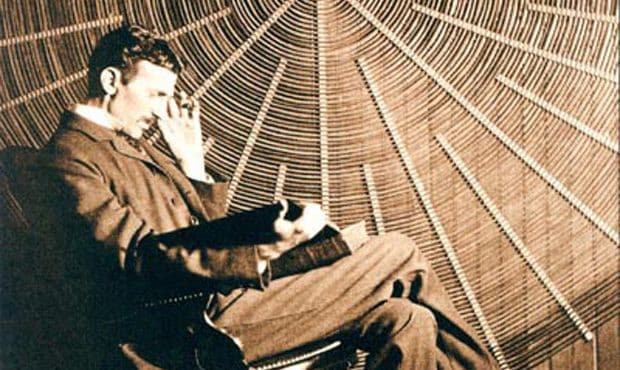
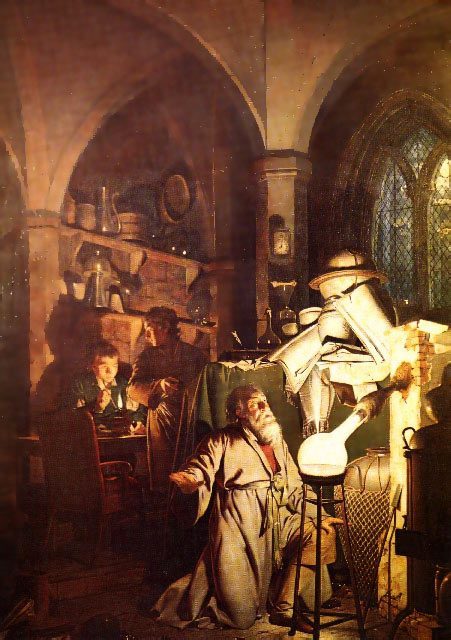
The Place of Imagination is where the imagination is quickly stirred and released. It is domain and center of power of a worker of the imagination. The alchemists had their labs; the ancient philosophers had their caves; Europeans, the forests; lamas, mountainside retreats; and genius makers (i.e. Edison and Tesla), their workshops.

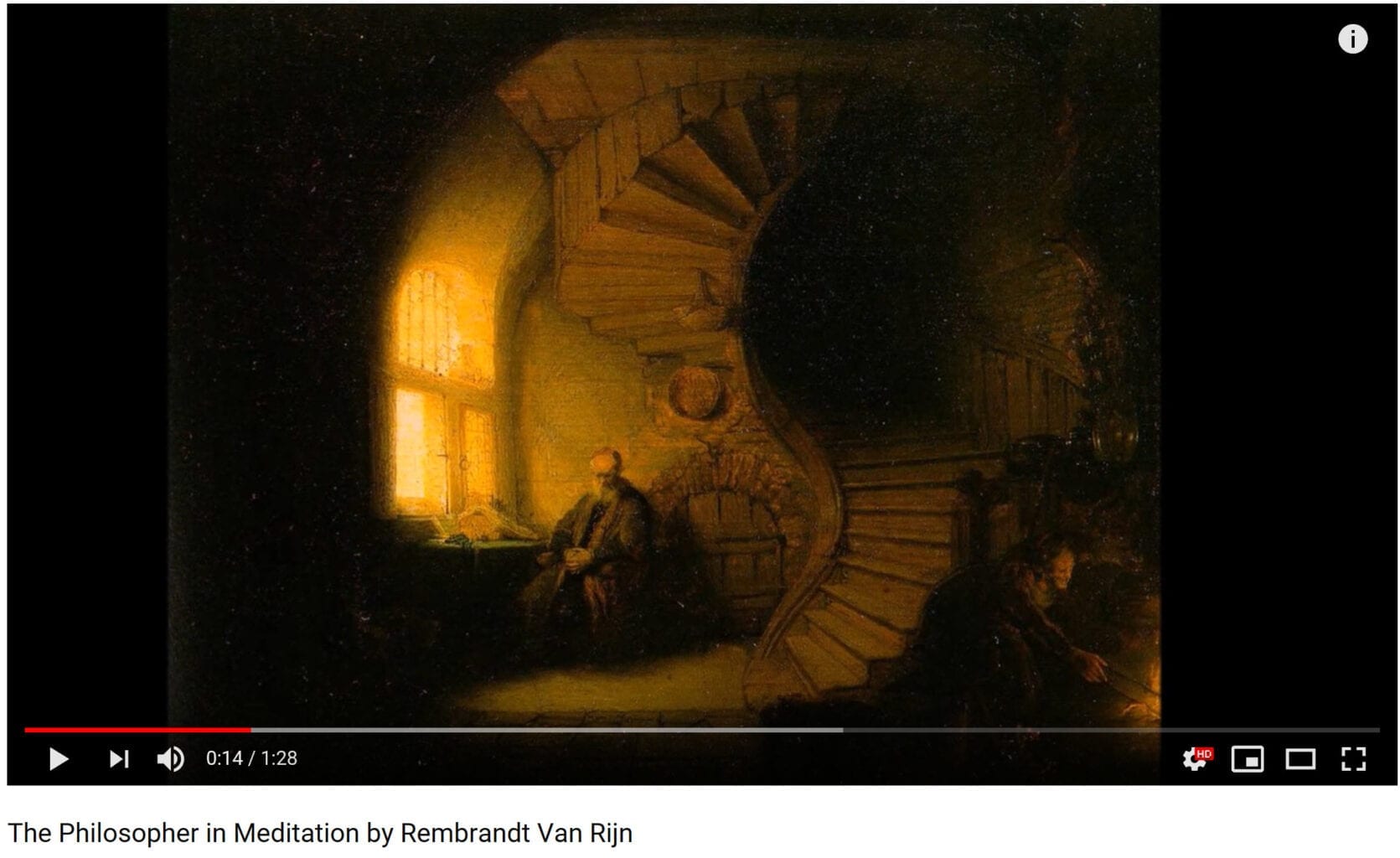
Rembrandt really captured the essence of a Place of Imagination in his painting called The Philosopher in Meditation (shown above). We see a combination of sunlight and fireplace light, perhaps representing the analytical or conscious mind, and darkness that intensifies up the spiral staircase, a swirling force that pulls us into the unknown and unseen unconscious. The imagination awaits the philosopher who sits looking downward, turned away from his book.

Here is a video of the painting with zooming, turning, and varied contrasting:

YouTube video showing close-ups of the painting.

A clearer wood carving shows some of the hidden detail submerged in Rembrandt’s original:

Finding Your Place of Imagination

You probably already have one but the work-a-day world keeps you from remembering the location. Slow down and spend some time and think if you have been in a place of magic (for you). This place can be in the real world or a place of your imagination.

When you find it, and sometimes it has to be constructed from two or more locations combined imaginatively into one place, explore it. Find its qualities. If need be, furnish that place with special objects that fascinate you.

Lock it in by making this the place where you start your imagination work. In time, this will be your Place of Imagination.

Energy Wizard Tesla

The Alchemist in Search of the Philosopher’s Stone, by Joseph Wright, 1771
01 Visualize - Articles, 04 Imagine - Articles

What is Your Calmer Self-Image? How to Build One

We can pretty easily describe a metaphorical image of what we look like when we are highly stressed. For instance, we may refer to ourselves as a “wild-eyed, wild hair, raging beast” or a “racing tornado just like my mother.” Or we may see ourselves as a “warrior, battling the world.”

It is worthwhile to watch ourselves carefully when we are stressed to spot additional details of this inner character we play when things are not going well. This is not a casual, unimportant imagining of our minds for our minds take this stuff very, very seriously, indeed. The mind, and more specifically, the unconscious, loves this stuff. It is a primary fuel for our inner world.

If we run inner dramas of with us being a wild, barely in control character, we will live that role out. If our go-to role is harried, I can’t believe nor accept us with every stressor there is no room and no experience playing a different role.

But there are many other roles we can, with lots of practice, learn to act out. We see them in literature and movies:

The Clever, Self-Possessed Hero – These characters range from Sherlock Holmes to James Bond, to Laura Croft.

The Wise Person – Usually associated with the wise, old male, this characterization of a calm person is not limited to men. Many wise women who can see the big picture, hold things in perspective, who are patient can also be found.

The Centered and Detached Sports Person – Think balance-beam gymnasts; professional poker players, golfers.

The Bounce Back Person – We find these not only in literature but in life; the person who goes through tremendous trials but comes right back and keeps on keeping on.

The Immersed Artist/Craftsman/Worker – These people immerse themselves into something finite but seem to get almost infinite vitality, enjoyment, and relaxation from what they are doing.

The Keep to the Simple Person – Look for literary characters who keep a simple life that stands in contrast to the people spinning, busily around them.

How to Build Your Inner Relaxation Self-Image

1. Find an image from the list above (and from your list) the clicks for you. Note, it doesn’t have to be a single inner character. Our stressed out inner image is usually made of a little this and a little that, so you can make your relaxation self-image a little this and a little that, too.

2. Imagine that self-image a little bit each day for a month. We are talking about a few minutes each day. Do this until you feel connected to your image and that it is very clearly in mind.

3. Bring your self-image up in stressful but lower stress situations and start to act as if you are that image. See what you discover.

4. Apply imagining that self-image to memories of stressful situations and see what you can imagine as how you would have responded as that sort of character.

5. Practice, Practice, Practice steps 1 through 5. It takes awhile to develop our stressed-out image, it will take time to develop an inner image we know can pop up on its own when we are facing stress.

Photo attribution info

01 Visualize - Articles, 04 Imagine - Articles

Know Your Relaxation History

Switching from concern about stress let’s look at the other side of the coin, at relaxation. What is your history of relaxation?  What I mean is what has relaxed you?  Do you remember? Do you remember several sources of relaxation for you?  I know, it is hard to remember, at least most of the time, what has worked for us over the years.  No time to look backward we automatically concluded, got to take care of today.

Seriously, what have been things, places, people, and events that have brought you peace and perhaps brought you very positive feeling?. Take your time, don’t rush.

What brought you peace, relaxation within the last six months?
The last year?
Over the last 5 years?
Ten years?
When you were quite younger?

Again, don’t rush it. You don’t have to come up with everything right now, think about adding to your list over the next few days but be comprehensive. Dig deep. Pull hard. Assemble your list of what has worked for you, whether it was large or small, still possible to repeat or impossible to have again, what did it for you?

Look at the list. What was it that gave you that relaxation? What were the qualities of the person, place, thing, event that had such an impact on you?

Which are your top three?

Can you find and experience them again?

01 Visualize - Articles

Subtractive Visualization

Man looking at night sky of the dreamer

Most visualization involves the addition and morphing of imagery. Here we look at something different, when visualization is used to subtract imagery.

The Stoics, early Roman philosophers who focused closely on what causes suffering (like the Buddhists) used negative visualization to live more calm and simple lives. They would routinely visualize not having something they already possessed or had a relationship with (a friend or family member). This feels like a loss and it has a way of alerting the mind and heart to have renewed appreciation for whatever one owns. So this work taught how to appreciate what we have rather than producing restless that comes with searching for something next, new thing. More at Life Hacker article here.

Other subtractive visualizations can’t be specifically identified with groups or individuals because they are ancient and current notions.

Washing – Ritual bathing or imagining submersion in water conveys cleaning away from unwanted stains or dirt. Washed, we are free of this substance and renewed.  Letting the dirt drain away we can see it leaving our sight/awareness.

Burying – Placing things in earth or at least covering over, subtracts something from our lives and puts it somewhere it where it will stay and stay away from us.

Burning – Fire transforms by heating away or turning something to raising fumes, again separating something from us or our lives and sending it away.

Letting something fly upward or sail away – A balloon is a good object to fill with some inner quality or experience and simply releasing to the sky. Likewise, putting something in a bottle and throwing it into the ocean promises that it will continue onward but it will separate from us in a vast, uncharted realm.

Open Focus is technique that has us switch our attention to undefined space that is around us and in us. Our minds are good at grabbing things but space?  A new experience.  It is something that is barely graspable and therefore switching to space we switch to having no or very simple thoughts and very limited associations to memories. We are much freer than usual. See more on Open Focus here.

Next Steps:

– Give some of these visualizations a try.
– Notice which one works best for you in terms of releasing and refreshing.